
Software structure
Within these modules, user uploads input data for shoreline observations, wave forcing, and, optionally, sea level variation. These data are transformed and applied within a variety of models, using transect-based techniques for simplified, computationally-efficient calculations.
COMPRISED OF FOUR MODULES:
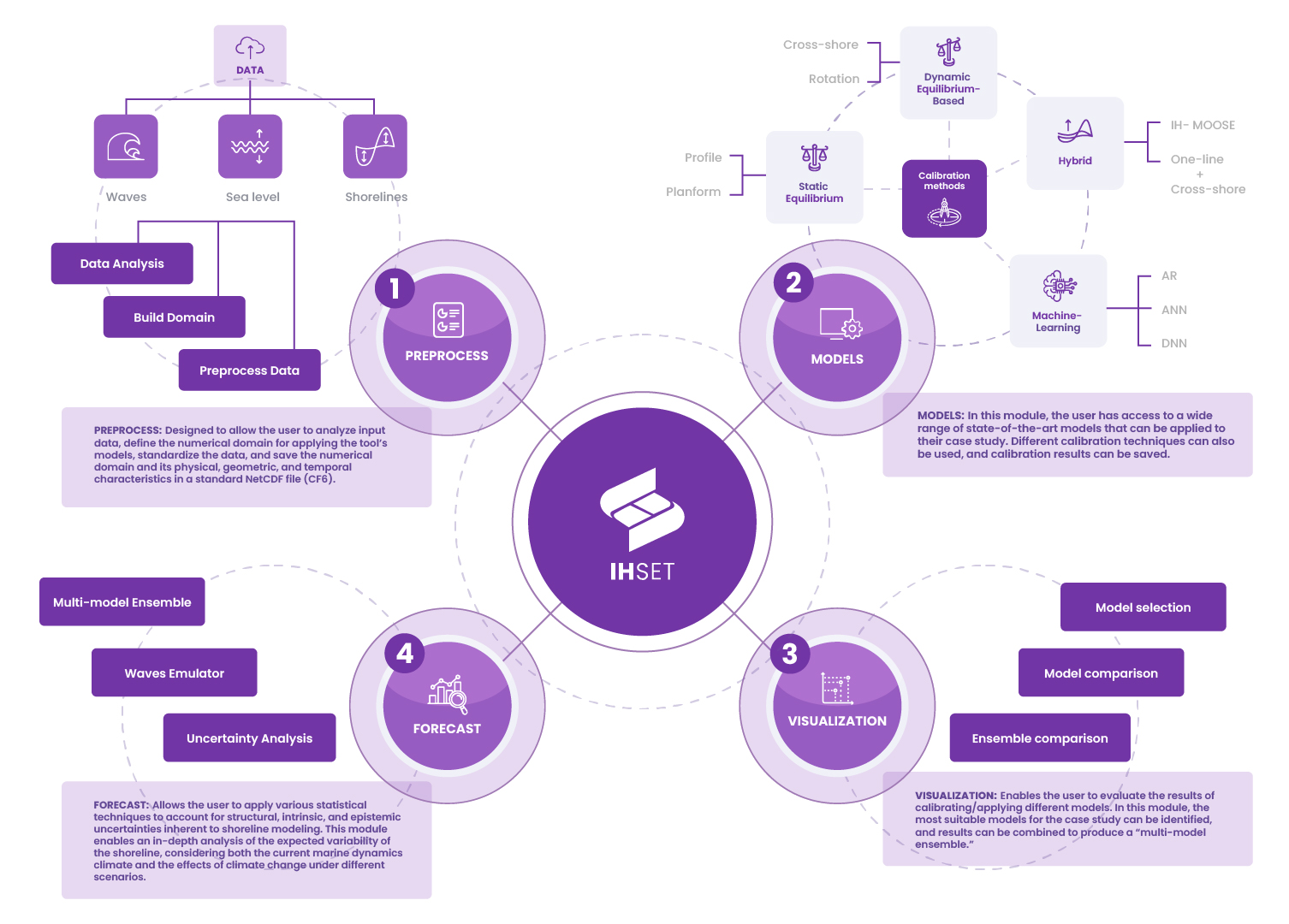
Preprocess
All these models require the following sets of input data:
Since wave forcing data is the primary input for the IH-SET models, results can be generated across the full range of wave data provided, allowing for both historical representations and calibrated predictions of shoreline evolution. Multiple wave forcing files can be provided from different stations, which will be interpolated and applied to the nearest transect to improve model accuracy.
Sea level data can be optionally provided as additional input forcing to refine simulation results.
Shoreline observations, in combination with advanced calibration techniques, are used to determine the free parameters for each model, allowing for the accurate validation of past records and prediction of future shoreline evolution. In the Preprocess module, the user establishes the transect-based numerical domain that serves as the basis for viewing and applying these observations within the software.

Models
Coastal morphodynamic models are typically classified based on several criteria, including their nature, level of accuracy, temporal and spatial scales, as well as the variables incorporated into the formulations. These tools can also range from simplified models based on empirical static equilibrium formulations, designed for rapid environmental diagnostics, to more sophisticated models grounded in dynamic processes for comprehensive investigations of coastal morphodynamics. However, despite their complementary nature and the close relationship among their outputs, the lack of interoperability has posed challenges in their real potential for coastal analysis.
Thus, the primary objective of IH-SET is to integrate the static, dynamic, and evolutionary approaches to morphodynamic modeling into a singular tool, facilitating the efficient prediction of coastal evolution on multiple temporal and spatial scales. The models included in IH-SET fall into the following classes:

Each class of model can be used independently or in combination for easy comparison and analysis, and each model addresses specific aspects of shoreline evolution, providing flexibility to accommodate different time and space scales for diverse study requirements and design objectives.
Static Equilibrium
Models considering that the modeled process will vary temporally around a static equilibrium condition and include expressions for the beach planform and profile shapes.
Dynamic Equilibrium Based Shoreline Evolution
Models based on the hypothesis of orthogonality of beach processes. These can be decomposed into transverse and longitudinal sediment transport and respond respectively to the evolution of the beach cross-shore position or to the variability of its orientation.
Hybrid
Models combining cross-shore and longshore transport processes to extend the one-line or rotation models model approach adding up the cross-shore component.
Machine Learning
Under development
Mathematical models used in timeseries regression context, where the position of the shoreline is predicted based on the available forcing.
Visualization
The Visualization module is the final necessary component to fully achieve our goal of providing a unified, versatile, and efficient software for coastal modeling. This tool allows users to view previously saved results and compare multiple simulations of shoreline evolution, supporting a streamlined side-by-side analysis of different models. By adding multiple model simulations, users can evaluate their performance using various comparison metrics, such as accuracy and fit. This feature provides a unified interface for visually comparing the outputs of different models, helping users identify trends and differences. Additionally, users can save or export the visualized results for further analysis or documentation.

Forecast
Module under development.
